
Bourbon: The Variety That Built Modern Coffee
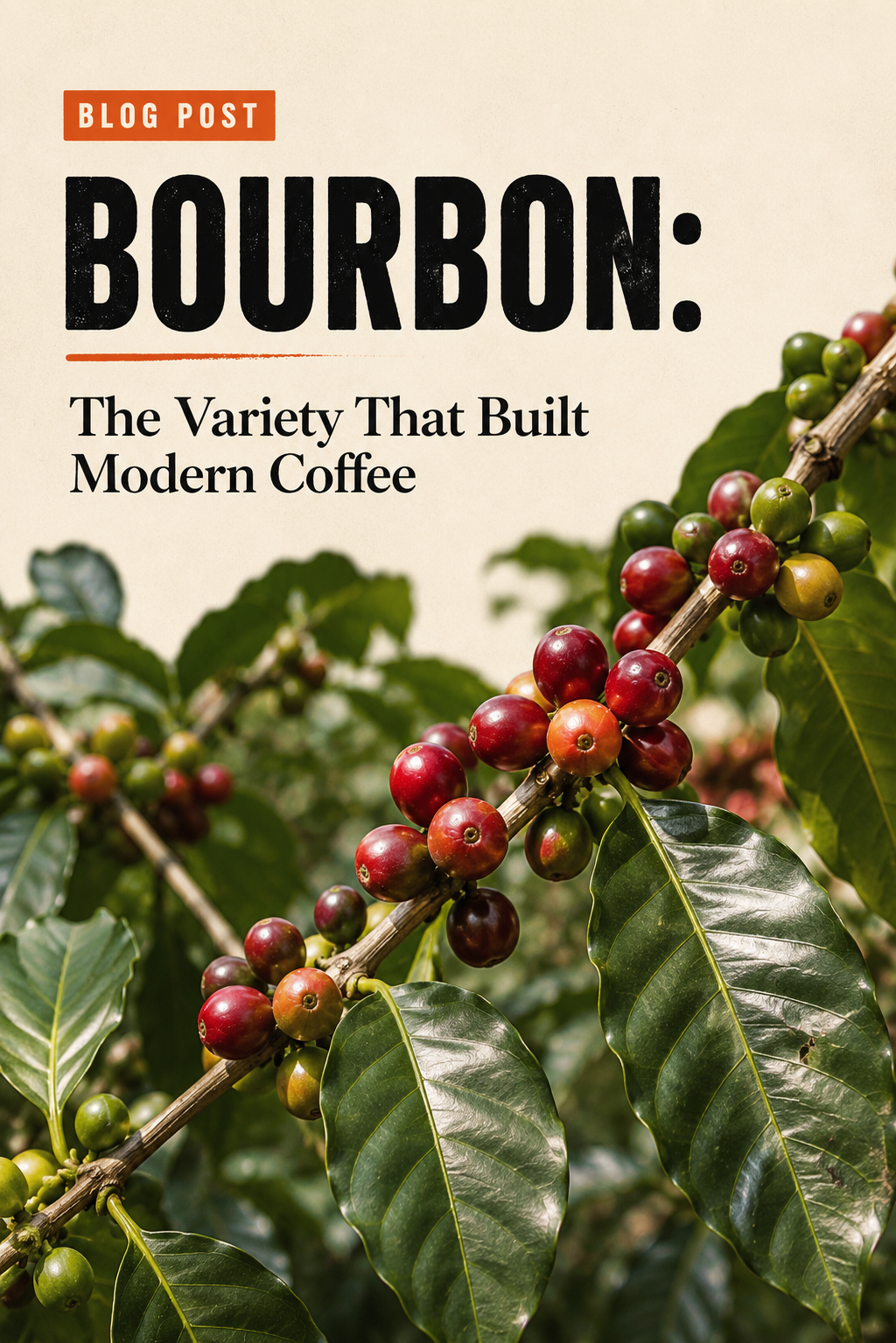
How a narrow handful of seedlings on a French-occupied island in the Indian Ocean became the parent of almost everything you drink.
The Mother Variety
Most of the cultivated coffee you've ever tasted traces back to one of two ancestors: Typica or Bourbon. Out of the 133 accepted species in the Coffea genus, two cultivars of Coffea arabica — both originally pulled from the wild forests of Ethiopia, both passed through human hands for centuries — built the modern coffee map. SL28, Pacamara, Caturra, Catuaí, Mundo Novo, Pacas, every Bourbon-derived East African coffee. Most of what gets poured at most cafés on most days owes its lineage to these two plants.
Bourbon is half of that origin story. And the way it got from Ethiopia to your espresso machine is one of the most improbable runs in agricultural history.
From Ethiopia to Yemen
Coffee starts wild in the Ethiopian highlands. Sometime around the 1300s — exact dates are murky, the way most pre-industrial agriculture is — seeds were carried across the Red Sea to Yemen, where humans first cultivated the plant on purpose rather than foraging from the forest. Yemeni terraces became the world's first coffee farms. For roughly 300 years, the entire global coffee trade ran through one port: Mocha.
This is where the family tree forks. Two Yemeni cultivars — Typica and what would later be called Red Bourbon — escaped that port and traveled in different directions. Typica went east, eventually to Indonesia and the New World. Bourbon went south.
1715: A Narrow Escape
On September 25, 1715, the French East India Company put sixty coffee trees on a ship bound for Bourbon Island — what we now call Réunion — a small volcanic French outpost off the east coast of Madagascar. The crossing was brutal. World Coffee Research notes that only a small number of Bourbon introductions actually succeeded on the island, which means the genetic bottleneck at the founding of the variety was severe — a tiny handful of plants seeding the entire lineage that followed.
A tiny bottleneck. That's the foundation of what would become Red Bourbon.
The variety took anyway. By 1718, the surviving stock had thrown over 100 seedlings. By 1720, roughly 7,000 trees. It adapted to volcanic soil, to monsoon humidity, to a climate that looked nothing like the high terraces of Yemen. And it sat there, on a small island in the middle of the Indian Ocean, for the next 150 years.
A Century and a Half of Drift
Here's what most people don't talk about: Bourbon spent more time on Réunion than it has spent anywhere else on the planet. From 1718 to roughly the 1860s, it was a regional heirloom — passed down generationally, planted in private gardens and small holdings, hand-selected by growers who weren't optimizing for yield or export. They were optimizing for what grew well, what tasted good, what their families wanted to drink.
That's not commercial agriculture. That's husbandry. The same kind of slow, generational adaptation you see in heirloom tomato seeds or working-line German shepherds. The plant became a Réunionese cultivar in a real sense — its genetics shaped by 150 years of soil, sun, and human preference.
When Bourbon finally left the island, it left with that lineage already baked in.
The Great Spread
Starting in the 1860s, Bourbon began moving. French missionaries carried it to East Africa. It landed in Tanzania, then pushed north and west — Kenya, Rwanda, Burundi, Uganda. It crossed the Atlantic to Brazil and Central America, where it joined Typica in becoming the foundational variety of the New World coffee belt.
The early 1900s brought Bourbon to Rwanda specifically. By the 1930s and 1940s, the Belgian colonial government had forced large-scale coffee production across the region — coffee growing became mandatory under their rule of the Belgian Congo from 1908 to 1960. By 1970, coffee was Rwanda's largest export, accounting for 70% of national export revenue. By 1973, tearing a coffee tree out of the ground was illegal.
Today, Red Bourbon still makes up roughly 95% of Rwanda's coffee production. Burundi sits in nearly the same range. Two entire national coffee economies built on a single variety — which means when you taste a washed Rwandan or Burundian, you're tasting a remarkably transparent picture of that region's terroir, because the variable of cultivar is held basically constant.
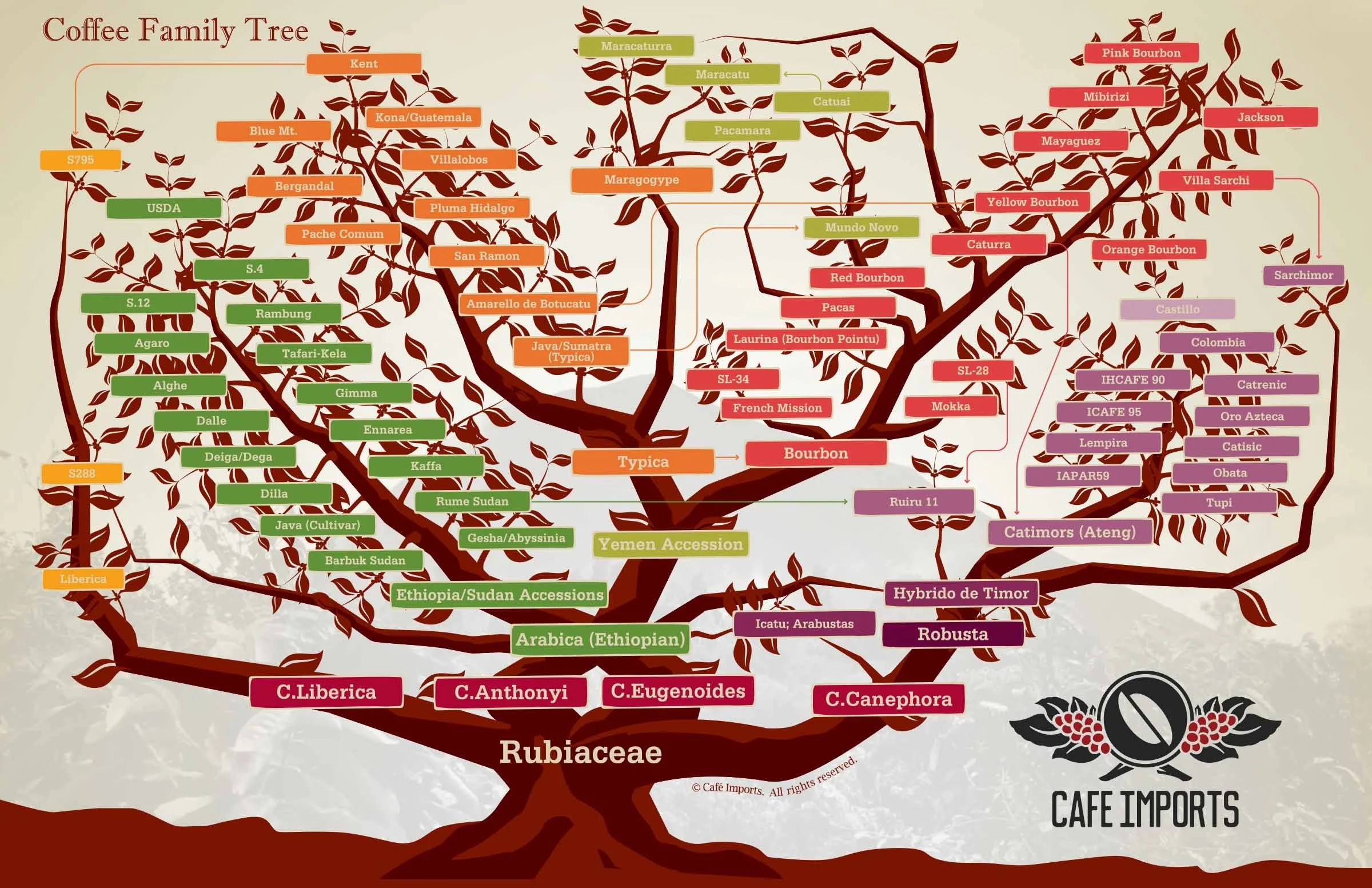
Coffee Family Tree © Cafe Imports. Source: Cafe Imports.
Bourbon's Children
This is where it gets interesting. Bourbon didn't just spread. It bred.
Yellow Bourbon. Sometime around the 1930s, in Brazil — about eight decades after Bourbon arrived in the New World — a natural cross occurred between Red Bourbon and a now-rare variety called Yellow Botucatu. The result was Yellow Bourbon, named for the gold-amber color its cherries ripen to instead of the standard red. It's still grown widely across Brazil and carries a slightly different flavor presentation than its red parent — typically rounder, with softer acidity.
Caturra, Catuaí, Mundo Novo, Pacas, Pacamara. All of these — the workhorse varieties of Latin American specialty coffee — have Bourbon in their pedigree. Caturra is a natural dwarf mutation of Bourbon discovered in Brazil in the 1930s. Catuaí is a Caturra × Mundo Novo cross. Mundo Novo is itself a Bourbon × Typica hybrid. Pacas is a Salvadoran Bourbon mutation. Pacamara is Pacas × Maragogipe. The family tree branches out fast.
SL28 and SL34. Kenya's flagship varieties, developed by Scott Agricultural Laboratories in the 1930s, both descend from the Bourbon-Typica group. The intense black currant acidity that defines great Kenyan coffee? That's a Bourbon descendant talking, after thirty years of selective breeding for the Kenyan highlands.
Pink Bourbon. Worth a clarification: Pink Bourbon is not actually a Bourbon. Genetic testing by Café Imports confirmed it's an Ethiopian landrace, unrelated to the Bourbon family. The working theory is that it escaped from the Cenicafé research farm in Acevedo, Huila, Colombia sometime in the 1980s, and producers — possibly because the cherries ripen to a pink-orange color reminiscent of the Bourbon family — started calling it Pink Bourbon. The name stuck. The genetics didn't match. It's a great-tasting coffee, but it's a marketing accident, not a relative.
What Bourbon Actually Tastes Like
This is the part the trade press undersells. Bourbon doesn't have the shock-value acidity of an SL28, the floral high notes of a Geisha, or the violent fermentation funk that anaerobic processing puts on display. It's quieter than that. It's a sweetness-forward variety with rounded, balanced acidity and a heavier body than its descendants tend to carry.
In a washed Latin American Bourbon, you typically get caramel, brown sugar, soft red fruit, sometimes a chocolate-forward base. In an East African Bourbon — Rwanda, Burundi — you get more sparkle, more clarity, often jammy red fruit (cherry, raspberry) and a cleaner finish. In Yellow Bourbon from Brazil, you get rounder sugars, less acidity, often a thicker mouthfeel.
What unifies all of it is sweetness structure. Bourbon expresses sugar in complex, layered ways — not the single-note caramelized sweetness of a hard-roasted commodity coffee, but a stacked sweetness where you can taste different sugar molecules doing different things at different stages of the sip. That's the inheritance.
Variety Matters
There's a long-running argument in coffee that variety is downstream of everything else — that soil, plant nutrition, cherry ripeness, shade, elevation, and processing are doing the real flavor work, and the genetic identity of the plant is secondary. The science backs this up to a point. Terroir is real. Processing is enormous. Roast matters.
I don't buy the full version of the argument, though. I've tasted coffees grown on the same farm, processed the same way, roasted to the same profile, where the only variable was variety — and the difference was night and day. Bourbon and Typica gave us SL28, gave us Caturra and Catuaí and Pacamara, gave us the entire Latin American specialty coffee industry. Geisha came from a completely separate Ethiopian-derived line — and the fact that it tastes nothing like a Bourbon, despite both lineages starting in the same forests, is itself the proof that genetics aren't downstream of everything else. If variety were truly secondary, those plants wouldn't exist as distinct flavor experiences. They do.
The variety is the instrument. Terroir and processing are how it's played. You need both.
Why Bourbon Matters Here
Bourbon isn't the trendy variety. It doesn't carry the auction prices Geisha does. It doesn't show up on tasting flights at competitions the way SL28 or Pink Bourbon do right now. What it does is show up. It's grown across more countries, on more farms, by more producers, in more conditions than almost any other arabica cultivar. It's the variety that's quietly held the entire specialty industry up while other plants got the spotlight.
That's the kind of foundation work we respect at Pit Stop. The plants that survived the ship. The narrow handful that founded a variety. The 150 years of slow, unsexy generational adaptation that no one wrote about while it was happening. The variety that built modern coffee while everyone was busy chasing the newest hype lot.
Run what you brung. The Bourbon stock that survived that 1715 crossing didn't have much working in its favor. It took root anyway. And from that narrow start, it built everything.
Want to taste it? Most of our single-origin lots from East Africa and Latin America carry Bourbon or one of its descendants. Check out our storefront for what’s currently on the bench.