Nashville Water Was Holding Coffee Back
Why some of the city's best coffees may have been muted by a problem most people never noticed
For a few years, something felt off in Nashville. Most people probably never noticed. The water looked normal, it was safe, and cafes kept brewing. Customers kept drinking. But if you were paying close attention to coffee, you could feel it in the cup. Acidity seemed blunted. Sweetness was harder to find. Coffees that should have tasted vivid and precise felt duller, muddier, and less alive than they should have.
Then, somewhere around 2023-2024, it started to change. The water seemed to improve, and the coffee improved with it. What makes this story so important is that the problem probably was not the minerals in the simple way most people think about coffee water. On paper, Nashville water could still look solid. The real issue appears to have been more subtle than that, and that should be a wake-up call for every coffee bar that assumes filtered water is automatically good water.
Water can look right on paper and still taste wrong in the cup
In coffee, water conversations usually stop at TDS, hardness, alkalinity, calcium, and magnesium. Those numbers matter. They shape extraction, balance, and structure. But they are not the whole story. Water can have a usable mineral profile and still hold coffee back.
That is the trap. A shop can test the easy numbers, feel confident, and still miss the compounds that quietly flatten flavor. Trace organic compounds, taste-and-odor compounds, and shifts in upstream treatment can affect the cup long before a standard mineral sheet makes anything look alarming. That seems to be what happened in Nashville.
The city’s own filtration may have been part of the story
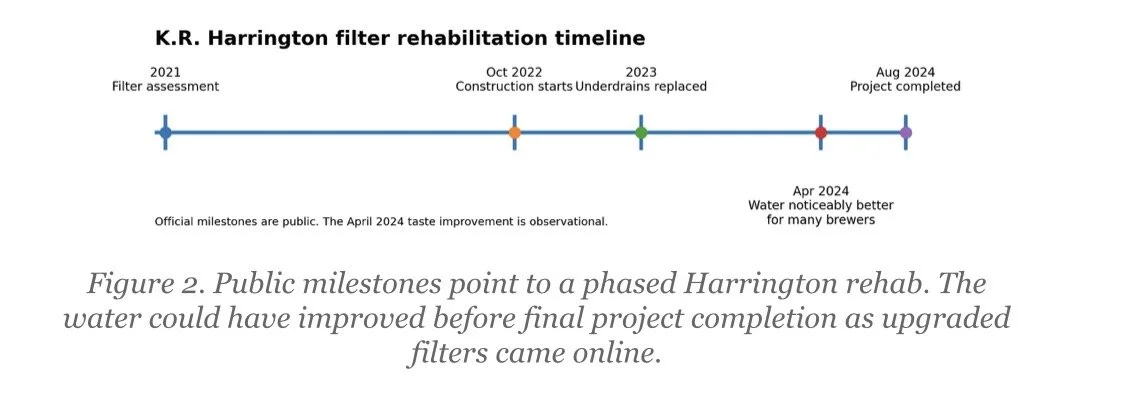
The strongest explanation points to the K.R. Harrington treatment plant and the rehabilitation work that took place there over multiple years. As aging filter systems were rebuilt and underdrains were replaced, the plant’s filtration performance appears to have improved. That matters because city-scale treatment filters do more than make water safe or visually clean. They help polish the water before it ever reaches the tap.
When that polishing step weakens, coffee can suffer even if the water still looks acceptable in a basic report. That means Nashville’s coffee problem may not have been about obviously bad water. It may have been about water that was good enough for most people, but not clean or stable enough to let great coffee fully shine. For coffee professionals, that difference is everything.
Two plants, one story, and more improvement on the way
Nashville is served by two treatment plants, not one. Omohundro, built in 1889 down on the Cumberland River, and K.R. Harrington, built in 1978 out at the confluence of the Stones and the Cumberland in Donelson. Each is rated at around 90 million gallons per day, and the water they produce gets blended across a shared distribution system of more than 3,000 miles of main. Most of Nashville is drinking some combination of both at any given moment, shaped by pressure zones, storage, and demand rather than any clean east-west line on a map.
That matters because the improvement most plausibly tied to the 2023-2024 rebound happened at Harrington specifically. Its 18 filters had been running past their prime, the underdrains were replaced in 2023, and the full rehab finished in August 2024 with filter run times reportedly increasing by roughly 300 percent. Omohundro’s filter building is older but its nozzles were updated back in 1999, so its filters were not in the same state of stress. That is probably part of why the sensory shift lined up with Harrington’s timeline rather than a citywide overhaul.
The bigger upgrade is still coming. Both plants are scheduled to receive new post-filter granular activated carbon contactors, the class of equipment purpose-built to pull out exactly the taste and odor compounds this article is describing. Omohundro’s modernization is underway now and will roll out in phases over the next decade-plus. Harrington’s GAC facility is also part of the broader plan. What Nashville got in 2024 was the first wave. The real polish upgrade is still ahead of us.
What the plant was actually trying to scrub out
City-scale filtration is not a mystery. It is trying to remove specific things. Nashville pulls its water from the Cumberland River, and the river goes through seasonal algae blooms every year, roughly late spring through early fall. Those blooms produce two compounds worth naming: geosmin and MIB (2-methylisoborneol). Both are organic, both are harmless at these concentrations, and both carry flavors that coffee people recognize instantly. Geosmin is the smell of fresh-turned soil. MIB is closer to a damp basement or wet cardboard. Neither one is what you want sitting under a pour-over.
The striking part is the detection threshold. Humans can pick up MIB at around 3 to 6 parts per trillion. Parts per trillion. That is far below anything a standard mineral panel or consumer water report would ever flag. Nashville has been dosing powdered activated carbon seasonally to pull those compounds out before the water leaves the plant, and they have been doing that since before 1980. It works. But it depends on the downstream filter beds actually having the capacity and contact time to do their part of the job. When the filters at Harrington were stressed, more of those trace compounds had a chance to survive into distribution. Then they hit the chloramine stage, where leftover organic material reacts with the disinfectant and creates its own byproducts: trihalomethanes and haloacetic acids, that also affect the cup, in a different and usually drier way.
So when the conversation is about “water polish,” this is what is actually getting polished. Not minerals. Trace organics at vanishingly small concentrations, and whatever the chloramines decide to do with whatever is left over. A stressed plant lets more of that through. A healthy plant pulls it out quietly and the cup never knows.
Independent samples along with published Nashville metro water samples exposed the real testing gap
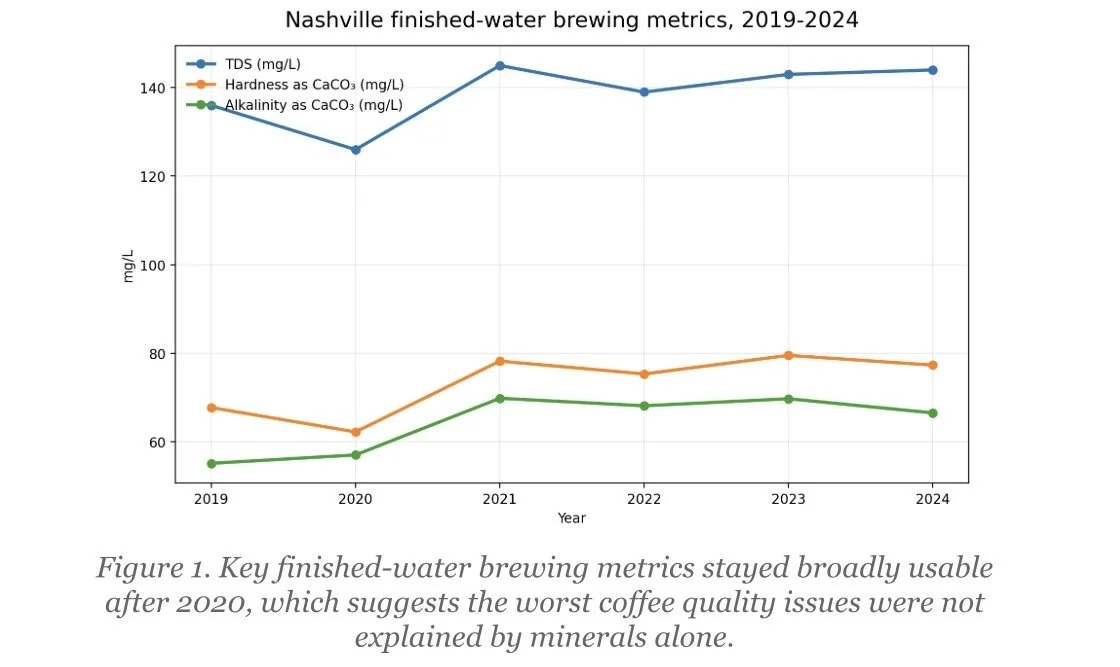
Our own findings from independent 2023 laboratory tests done on water samples from coffee shops in Nashville, along with yearly published data from Metro Water, showed a mineral profile that was actually quite workable for coffee. Yet many coffees still felt compromised during that stretch of time. That points to a bigger lesson. The part of water that damages flavor is not always the part most cafes are measuring.
Laboratory mineral testing is useful, but it does not tell the whole story. It can confirm whether your brewing ions are in range. It does not automatically tell you whether taste-and-odor compounds, disinfectant byproducts, or other subtle contaminants are suppressing clarity and sweetness in the cup. There’s more to this story…
This should be a wake-up call for the Nashville coffee community
If the water can drift this much without most people realizing it, then many coffee bars are probably trusting their water too easily. Not because they do not care, but because the industry often oversimplifies the problem. Too many cafes treat 'filtered water' like a solved category. It is not. There is a huge difference between a fridge filter, a standard cafe cartridge, a properly designed under-counter system, and a water setup that is actually engineered around flavor stability.
Those systems are not interchangeable. A coffee bar cannot afford to install a filter, replace it on schedule, and assume the problem is handled forever. Water changes. Source conditions change. Treatment changes. Distribution changes. Seasonal shifts matter. If your cafe is not actively testing, tasting, and adjusting, your water may be making decisions for you every day without your knowledge. That means your recipes can drift even when your baristas are doing everything right.
When the water got better, not every cafe felt it
Here is the part of the story that gets uncomfortable. When Nashville water finally improved, the cafes that were ready for it felt it immediately. Cleaner cups, better clarity, sweetness back in place. But some shops did not notice the change at all, and a few actually started pulling cups that tasted worse than before. Chalky. Dry. Flat in a new way that had not been there when the city was still running rough.
A tired filter can sort of get away with it when the upstream water is already compromised. The bar is low. Everything is a little off anyway, and a cartridge past its real lifespan gets hidden in the noise. But when the upstream water finally gets clean again, that same worn-out filter becomes the limiting factor in the cup. Carbon saturates. Media channels (much like a percolation brew!). Resin beds lose capacity. A filter that was quietly doing nothing for months suddenly gets exposed in a roundabout way, because there is nothing left in the water to now blame. The shops running with properly designed systems felt the city’s improvement immediately. The ones coasting on neglected filtration got caught.
Your filter is probably already done
Here is the uncomfortable math. Most cafe filters are rated in gallons, not months. That rating is a hard capacity limit tied to how much water the cartridge can actually treat before it stops doing its job, not a suggestion that renews on the calendar. And real cafe water use blows past that rating much faster than most shops realize.
Take a C300, a common ion-exchange cartridge in specialty coffee. It is rated at 660 gallons at 0% bypass, or roughly 915 gallons at 30% bypass. A busy cafe pulling 325 drinks a day — 150 espressos, 150 drips and cold brews, 25 pour overs, 25 teas — runs through about 28.5 gallons of water per day once everything is accounted for. And it is not just brewed coffee. Pitcher rinsers, grouphead purges, hot water towers, end-of-shift soaks, steam production. It all counts. Brewed coffee alone absorbs more than 220% of its weight in water, and the total water demand on a filter is always higher than the brew counts suggest.
Now run the numbers. At 28.5 gallons a day, a 660-gallon C300 hits its rated limit in about 23 days. Alkalinity starts muting acidity somewhere around day 19 to 21. Scale starts slipping through in under three weeks. A 30% bypass setup stretches that out to roughly 32 days. That is still measured in weeks, not quarters, and definitely not years. If a shop is replacing that filter every six months, they are already 21 weeks overdue. If they are replacing it once a year, the espresso machine is cooked and the coffee has been tasting flat and muted for roughly 11 of those 12 months.
That is how specialty programs quietly drift off the rails. The filter stops doing its job long before the reminder goes out, and nobody tastes it as a cliff, it shows up as the slow, unexplained dulling of a menu that used to shine. Same goes for the health of the boilers and machines running this poorly treated water, leading to brewing, heating and flow-rate issues that change from group head to group head. It’s a vicious cycle.
Filtered water is far more complex than most people think
One of the biggest misconceptions in coffee is that filtration is simple. It is not. Flow rate matters. Contact time matters. Media volume matters. Bypass matters. Pressure matters. Storage matters. Maintenance matters. Source-water swings matter. The same filter can behave very differently depending on how it is set up and how quickly it is fed.
This is why a basic under-counter filter is not always enough to protect flavor. If water moves too quickly through the media, the system may still be doing something useful without truly doing enough. It may protect equipment. It may reduce obvious chlorine character. But it may not be polishing the water at the level required to defend a high-end coffee program when upstream conditions get strange. That is where many cafes lose flavor without realizing it.
Most standard cafe filtration setups aren’t designed to match the activated-carbon dose, media volume, contact time, or ongoing monitoring that municipal treatment uses to handle trace taste-and-odor compounds like geosmin and MIB. A cafe filter may reduce some of that burden. It should never be assumed to remove it entirely.
Why slower, more intentional filtration may matter
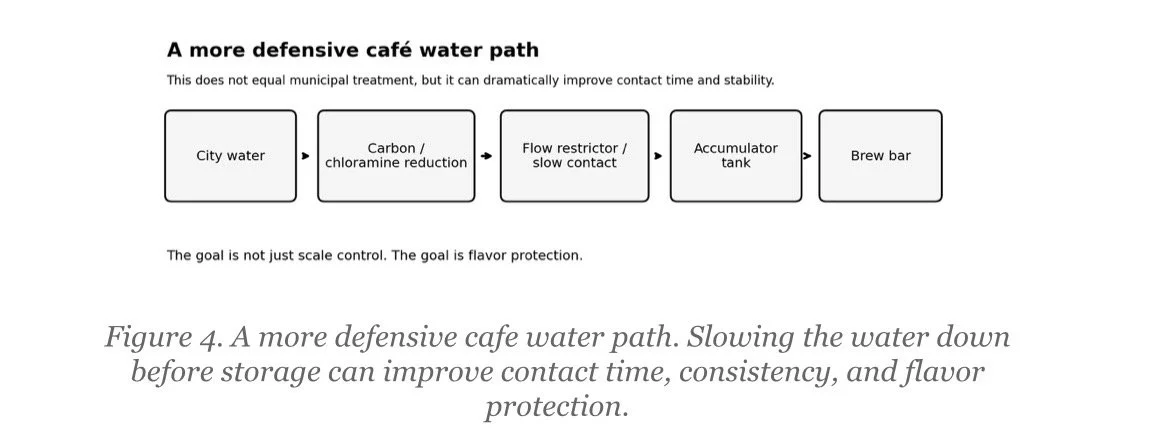
A municipal plant gives water minutes of contact with its media. A cafe cartridge under line pressure gives water seconds. This is one of the most overlooked parts of water design for coffee bars. Slower filtration can matter because contact time matters. Flow restrictors, accumulator tanks, and deliberate slow-fill setups may help a water system do a far better job of polishing water before it reaches the brew bar. That does not magically turn a cafe filter into a municipal treatment plant, but it can move a shop much closer to real protection and real consistency.
In some cases, ultra-slow under-counter systems may be one of the smartest ways to squeeze more performance from compact filtration. The goal is not just to reduce chlorine or protect an espresso machine from scale. The goal is to create water that stays flavor-positive even when the city shifts underneath you.
Why experience matters
Anyone can install a filter. Anyone can swap a cartridge. Anyone can read a TDS meter and say the water is 'in range.' That is not the same as understanding water. Real water management means knowing how water behaves in the cup. It means recognizing when the city has changed before customers do. It means understanding when a system is helping and when it is quietly holding the coffee back.
It means knowing when to test, when to adjust, when to slow things down, and when a standard solution is no longer good enough. That kind of experience is not extra. It is essential.
The bottom line
For a few years, Nashville coffee may have been limited by water that looked fine to almost everyone. Not because the minerals were obviously terrible. Not because anyone stopped caring. Not because the coffee itself was worse. It happened because water is more complicated than most people think, and because good-enough filtration is often not good enough at all.
Great coffee is fragile. Water is not a background detail. It is one of the most powerful ingredients in the room. If we want to brew coffee at a truly high level, we have to treat water like the living, shifting, complex ingredient that it is. Anything less leaves flavor on the table.
If you ask me, right now at least, our water is luckily pretty damn great! Better than what I could get with other mineral compounds as the mineral structure is different from most and produces a sweeter cup with more depth/dimension. More on this later.
You don’t need expensive minerals and an external distilled water source to make Nashville coffee taste great anymore. There are no more excuses for bad coffee, for now…
Full filter-lifespan charts and bypass math are on our Instagram @pitstopcoffeeco
Research basis
This article was developed from public Nashville Metro Water Services reports and project disclosures, the 2022 WIFIA loan agreement for Omohundro and K.R. Harrington process advancements, the 2025 MWS annual report, an East Nashville Ward Laboratories sample from December 2023, and in depth research findings from other various sources. Where public records do not directly confirm sensory causes, conclusions are presented as informed hypotheses rather than settled fact.
• Nashville Metro Water Services: 2020-2024 water quality reports and consumer confidence reports
• WIFIA Loan Agreement: Process Advancements at Omohundro and K.R. Harrington Water Treatment Plants
• Metro Water Services 2025 Annual Report
• Independent Ward Laboratories East Nashville water sample, December 2023